Tuesday, October 4, 2011

Feasting on Fungus

"There are old mushroom hunters and bold mushroom hunters, but there are no old, bold mushroom hunters"  
This is the well known mantra of many wild mushroom eaters, and as cheesy as it may sound it is a good thing to keep in mind if ever you are considering eating a mushroom you have found anywhere but the grocery store.  

With this understanding I have ventured this fall into the world of delicious and intriguing edible mushrooms.   The following is a synopsis of the mushrooms which I have picked and eaten in the last month or so.   There are not many but they have been delicious and I have learned a lot about mushrooms which has been extremely satisfying.  

These are Common Oyster Mushrooms.  Notice that the Gills (the deep furrows which hold the spores) extend down the stem of the mushroom.   Also, the stems are slightly off-center which is very typical of Oysters.  The mushroom it's self is delicate and smells appealing.   This specimen was growing on a standing hardwood tree - although I found several other nice Oysters nearby which were growing on a dead and horizontal hardwood.   These particular mushrooms had little black beetles infesting some of them which was actually a welcome thing as they are another identifying factor.   There are many species of Oyster mushrooms and none are poisonous, though some are less palatable.  There are no poisonous lookalikes therefore this is a fairly safe mushroom to eat without concern.

Following a recipe that I found I battered them and breaded them with cracker crumbs and then fried them in butter.   I only ate two - it is always good to start with a small portion as some people have allergies, or may react negatively even to non-poisonous wild mushrooms.  The flavor was delicious although the texture was a bit slimy and not my favorite.   None the less, the experience was great and I will not hesitate to eat them again, perhaps trying another way of preparing them.  
 
It's a strange thing, I know, but I dreamed about these mushrooms the night before I happened upon them as I was running on a trail near my house.  I was actually not expecting to find these brilliantly orange Chanterelles, called Cinnabar Chanterelles.  You can be sure that I was extremely happy to find them and they were one of the reasons I became so fascinated with mushrooms this fall.  They are small but found in abundance.  In fact, I have found so many of them that I no longer always stop to pick them when I am out running (although I am always ridiculously delighted to see them)

Cinnabar Chanterelles have a fantastic flavor - this Quiche was one of the best I have ever made, deriving it's flavor from the sauteed Cinnabars.

A bit later in the season I started finding regular Chanterelles.   They are amazing.   Take a look at the "false gills" that these mushrooms have.  They are shallow ridges that extend a ways down the stem rather than the more severe and "sharp" gills of many mushrooms.   Chanterelles are brilliantly colored and these, unlike the Cinnabar variety, are not extremely delicate.  

Chanterelles have an flavor that you have to experience in order to understand.   They have a richness which is awesome and addicting.  I can see why people look forward to Chanterelle season all year long.   These "Chanterelle Puffs" were amazing!

Chanterelles, however, can be a bit trickier than Oysters to identify correctly.   These are some sort of "Gomphus" mushroom - they do not have true gills and could easily be mistaken for Chanterelles - however, the gills are deeper than Chanterelles' gills are and the velvety dark patch on the top of the mushroom cap is a give-away that they are not Chanterelles.   


These "Vase Chanterelles" also can be deceiving - but once you know what to look for they are easily avoided.   They are vase shaped - even holding water (sorry about the picture on the left, I took it with my phone on a day I realized that my sd card was at home).   They are quite impressive mushrooms.   Unlike the above mentioned Gomphus species, the "gills" on these Vases are very shallow and extend down the entire length of the mushroom.

Once you can identify a Chanterelle they are very hard to mistake - but don't think that anything resembling a "Chant" goes.

These Black Trumpets I did not cook, which I highly regret.  I hope that I find some more as these were my favorite find this year.   They smell absolutely amazing - like fresh fruit.  I had been searching for them without success when I stumbled upon them at the farm as I was out cutting some ash poles.   They have a very short season and turn into to a slimy mess quite quickly.   A week after I found these I came upon a huge patch of expired Black Trumpets which was a sad day for me.    But, there is still time this year and I hope to find some to eat.  If not, I will have a fun challenge for the next mushroom season.  

I have many more mushroom pictures and much more information to post - yet this concludes my feasting for this year.   Let me leave you with a few photos of  Destroying Angels, a beautiful pure white mushroom which is amazing to look at but will try to kill you if you venture a bite:

Here is a link to Cornell University's Mushroom Blog which outlines a fascinating story about mistaken mushroom identity and near death:


Wednesday, September 7, 2011

Mayapples

American Mandrake, also known as Mayapples, Wild or Ground Lemon, Racoon Berry, Indian Apple, Wild Jalap, Maracocks, Citron and doubtlessly by many other names is deadly poisonous yet it also produces some of the most delicious wild fruits you will ever taste.  

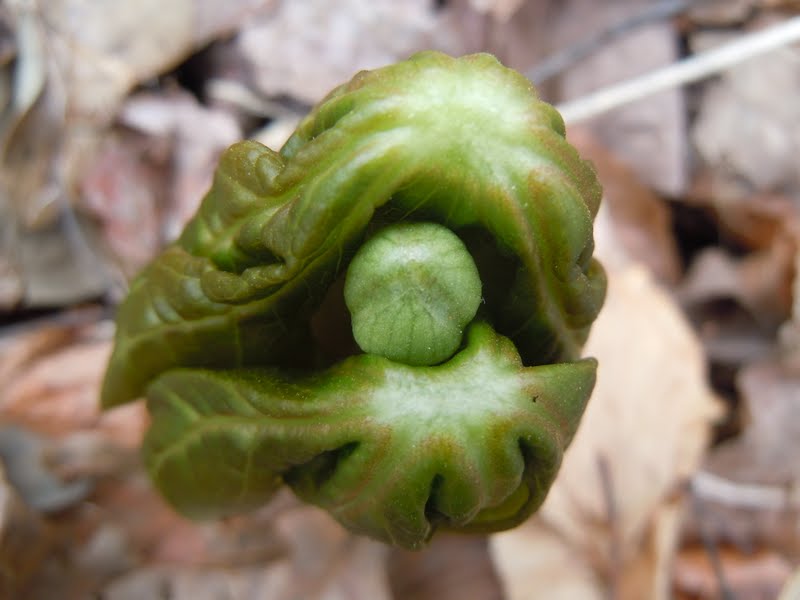
These are Mayapples in early April.   Like many poisonous plants Mayapples are also extremely valuable medicinally.   The Phodophyllin which is lethal in too strong a dose, blocks cell division and has been used widely and successfully in treating cancer.  

(Mayapples in early May)
American Indians used (and I would imagine still use) Mayapples for a variety of purposes.   The roots are used as a potent Cathartic (purging drug/laxative).  It has also been used to treat ear infections, warts, skin eruptions, syphilis and worms.  

Mayapple plant in mid-late May

Mayapples were cultivated by the Algonquins and probably by other Native people as well.
A good patch is hard to miss as they are very distinct in shape and are really quite lovely.

Here in upstate New York Mayapples flower in late May or early June.  The flowers droop underneath the umbrella-like leaves. 

Mayapples are mentioned by both Samuel de Champlain in Canada and John Smith in Virginia in the early 17th century.   Many accounts of Mayapple refers to it's use as a suicide drug or as a poison.   If you accidentally eat a Mayapple root, or too much of the leaf or stalk, inducing vomiting can save you - but if you do not do so death can occur in a matter of hours. 

Mayapple fruits have an indescribable taste.   All I can say is that you should look for them in August and try them out.  You will understand why I wait expectantly all summer to harvest them.

I prefer to spit out the seeds, although I have never heard of them making someone sick.
DELICIOUS!

Tuesday, August 23, 2011

Oswegatchie part 2 (mid June)


The moon rising over Hitchins Pond

The sun rising on Low's Lake

Early morning grey Low's Lake

This Indian Cucumber Root was almost three inches long and the plant was around three feet tall.   After subsisting on dried food for a few days these roots are amazing.   Sweet, crispy, cool and cucumberey.

A closer view of an Indian Cucumber Root flower
Eaten in large amounts this root can serve as a diuretic.  The berries and leaves were once used to treat convulsions in babies.   Also, the chewed up roots, placed on a hook, should make the fish bite.

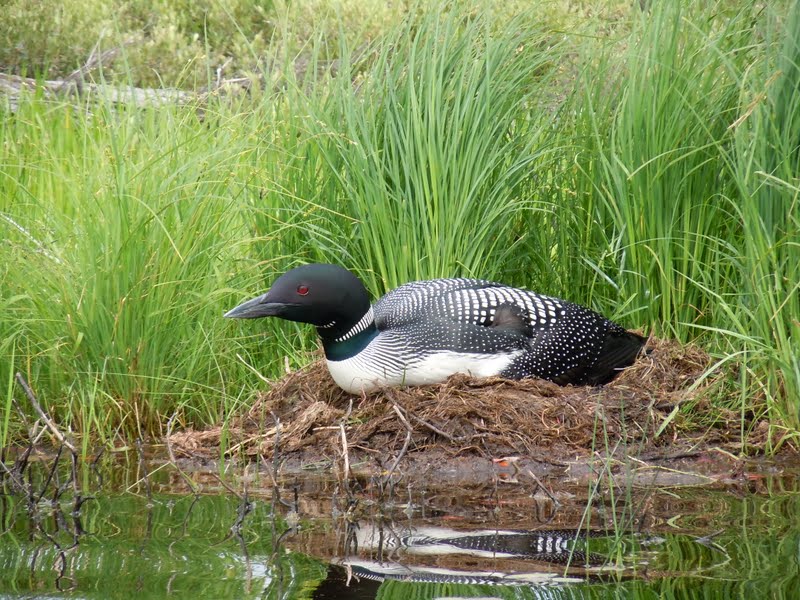
A beautiful Loon sitting on her nest at Big Deer Pond

Orange Hawkweed 

Clintonia, or Bluebead Lillies.  These lilies are past prime for eating the leaves as salad greens however they still maintain a pleasant cucumber-like aroma.

Tamarack Trees have a wide variety of uses.   The roots can be used to make twined or woven bags and also as rope for stitching materials together.   Young Tamarack shoots can be boiled and eaten as food and the Phloem can be made into flour.  Medicinally Tamarack is good for bruises, swelling and inflammation.  Leaves and bark can be burned and the fumes inhaled to treat headaches.  Tamarack also produces a pitch which can be used to patch leaking vessels and can be chewed as gum or candy.  

I won't pretend to be an expert fisherwoman but I will say that portaging 3.5 miles through beaver meadows in the rain was completely worth the trip down the Brook Trout laden river. There is nothing like fresh, pink Trout fried in butter after a long paddle.  

Fishing at High Falls

I can happily sit and stare for a very long time at the concussion of waters in a wild stream


Fishing the pool at the top of High Falls

The Black Waters reflecting the sky, brush and shadows

High Rock.  The last leg.

Laurels are very pretty to look at lining the marshy banks of the river

These plants are extremely poisonous.  Some cases of Laurel Poisoning have been blamed on eating honey made from these flowers.  They do have value when combined with fat and used as a poultice for headaches.   The only other uses I have seen consistently referenced for Sheep or Bog Laurel are for treating Syphilis and Mange (scabies).  Cases of accidental poisoning when using Laurels for treatments are frequently found.    Yikes.     

Oswegatchie at dusk


None of the berries, including these Serviceberries, were ripe for eating in mid-June

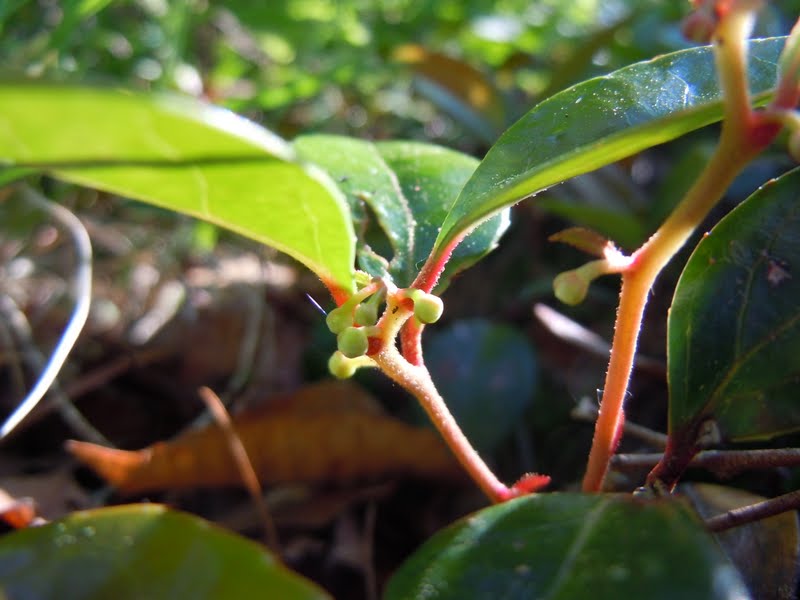
Tiny Wintergreen berries beginning to grow

Another week or so until these lowbush Blueberries are ready


The seeds of this Yellow Pond Lily or Bullhead Lily can be parched and eaten or ground into flour.   The root stock can be boiled and eaten.

Tuesday, July 26, 2011

Yarrow

If you have ever crushed up a few Yarrow leaves you already know that it is a delightful plant to have around.    The aroma is strong and very good. The benefits of simply smelling the leaves are similar to wild sages clearing your head and generally lifting your spirits. (I suppose simply taking a deep breath could contribute to this phenomenon, but the deliciously healthful scent can't hurt either)

Yarrow is one of my favorite wild plants (aren't they all).  Growing everywhere from farm fields to Adirondack meadows, this herb is reportedly a transplant from Europe, however, some sources say that the best Yarrow is North American.  I have an account of Yarrow being touted as an important medicinal plant as early as 1633, so if not actually native to North America, it has certainly been here for quite a while.  Yarrow has also been called Woundwart, Knight's Milfoil and Devil's Plaything.  The name "Woundwart" undoubtedly comes from it's widespread use to staunch bleeding and treat open wounds.  Yarrow has also been commonly used to treat headaches and migraines by making a tea or poultice.  The Flavonoids contained in Yarrow increase production of both saliva and stomach acid making the plant an effective digestive aid.  Yarrow can be a mildly inebriating sedative, the benefits of this property having been used to treat anxiety, "sickness of the head",  insomnia and soreness in the joints.  It has been proven to relax the smooth muscles of the body which also aids in digestion and eases menstrual cramps.  Yarrow can also be used to induce sweating in order to break a fever or chase off a cold.  
Marginal uses include treatment for worms, eczema, cancer, dysentery, nosebleeds and toothaches and for ceremonial smoking.

One of the American Indian accounts I found talked about the "white people" rubbing Yarrow on their heads to prevent baldness.  I also found an account of Europeans using it as a love potion by putting a sachet of it under someone's pillow to bring about dreams of their future spouse.

Most Yarrow is white with an occasional pink tint to it.  I found this bright pink Yarrow flower at the Adirondack Museum in Blue Mountain Lake.  

As far as edibility is concerned, Yarrow is sometimes used to flavor beer and I even found a recipe to make an "acceptable" wine from it.  

Tuesday, July 12, 2011

Summer

Summer is upon us with strawberries and sunshine (and also lots of rain).  My husband and I took a vacation in the Cranberry Lake wilderness region in the middle of June.   We canoed for who knows how many miles from Hitchins Pond to Inlet via Lows Lake and the Oswegatchie river.  We saw everything from Bald Eagles to Bears and even had a four day stretch were we did not see or hear any other human beings.  It was great.  

I think that we are constantly receiving sensory input of various artificial sorts which have an impact on our beings in a holistic sense.  We are advertised to relentlessly - while driving, listening to music, watching tv, going to school, acquiring food, walking down the street and so on.  We are also constantly hearing the hum of the refrigerator, the traffic on the highway, the airplanes and fans and air conditioners and buzzing of cell phones.  Someone told me once (I have no idea how this was discovered or if it's true) that spending one day in NYC provides you with as much sensory input as you might receive in a lifetime if you were a simple farmer only a few hundred years ago.  That is crazy.  At any rate, spending a length of time away from "civilization" as we call it seems to re-set my brain and it is very very good.  It gives me the lovely peaceful ability to slowly process every bird that flits by and every damselfly and flower and I even feel at peace with the mosquitoes and deerflies (I still slap them if they try to bite me but I don't really mind them making the attempt in fact I rather respect them for it).    

But, enough crazy talk about getting friendly with biting flies...
My wonderful neighbor Angela checked up on things at our apartment while we were gone and I thought it fitting to thank her with this small but delicious pile of wild strawberries.

They may be tiny but they pack a punch of sweet tart juicy goodness and they are pretty to look at besides.

Our first day of the trip took us through one of my favorite places near the Lows lower dam.  One reason I love this spot is because I have spent some unforgettable time there with wonderful friends.   Another is the Pickerel Weed.  

Pickerel Weed is a very versatile edible plant.   These unfurled leaves can be used as salad greens or boiled for a few minutes and eaten as a delicious and nutritious pot herb.  Later in the year I will collect seeds from the flowerheads which can be roasted, eaten raw or made into seed butter and oil. 

Don't think we ate this well for the whole trip - only the first night allowed for steaks, potatoes and Pickerel Weed with butter.  Pickerel Weed has a very mild flavor and was a lovely addition of greens to our dinner.  The unfurled leaves (picked while still underwater) were extremely tender.

Orange Hawkweed shares some pollen with this tiger swallowtail

Wintergreen leaves are best for chewing when they are newly emerged.  They also make an impressive ground cover in several shades of green and orange.

Northern Pitcher Plants are fascinating, insectivorous plants which trap flies in their "pitchers" and feed on the decaying flies.   The "pitchers" can be used as drinking cups.  Their reputation as a "love medicine" is not surprising considering the suggestive shape which they employ.

Pitcher Plant leaves, dried and made into tea can be used to combat fever and whooping cough.  When the Europeans spread smallpox among the American Indians, Pitcher Plant root and leaves were used to treat it, but without enough success to obliterate or manage the disease.   

The nodding flowers are dramatic and brilliantly colored.

This Roundleaf Sundew is another insectivorous plant frequently found in boggy areas.  The sticky tentacles trap small insects which the plant digests, absorbing the nutrients.  Sundew is used to wash-out freckles and get rid of warts.  It contains a chemical which acts as an expectorant therefore being useful for whooping cough, bronchitis, and the like.  

Of course, it is also a very nice plant to look at


Sundew and Pitcher Plants are often found on floating bogs like this one which drifts around in the Bog River Flow of Low's Lake.  It takes many years for a bog to develop - they consist of layers of Peat, root systems and debris all bound together.   Sometimes they become so dense that they hold trees and you can walk on them.  This one would not hold your weight and you would find yourself sinking dangerously if you tried to walk out onto it.  

This flower is starting to produce a cluster of bright red Bunchberries which, though tasteless, are very nutritious and usually abundant in the Adirondacks

This pretty little flower belongs to Wood Sorrel, a delightfully sour salad green which also grows quite abundantly in the Adirondacks.

Wild raisins, Witch Hobble, Hobblebush, and Wayfarer's Bush are a few of the names commonly given to this plant which has aloe like properties.   This may be due to the fact that Hobblebush secretes nectar through it's leaves rather than it's flowers.  In September the berries will turn wine-red and are a fine wild food though they can be scarce since they are also popular with the wildlife.  Medicinally it is used for shortness of breath or Asthma, and the crushed leaves have been used to treat migraines.   

Some fun pictures of Low's Lake


The Shoreline of Low's Lake

Black Cherries ready to start ripening

Much to my delight I found these beautiful Beaked Hazelnuts right outside of our campsite.  I was proud of myself, as I first recognized the leaves and sure enough, after looking underneath I found hazelnuts!  

In the fall these little nuts will be ready to devour - unless the bears get to them first

The Sunrise on Low's Lake was absolutely beautiful

At Big Deer Pond we found a doe and fawn chilling out on an island.  The doe carefully moved the baby to the middle of the island where they lay down and were pretty well hidden...  

...though they couldn't help watching us.  Deer can be very curious creatures.
(you can click on the photos for a better view)

And that covers less than half of our trip to the Oswegatchie.  Wow, I have a lot of blogging to do!